Phase 2, Part 2.
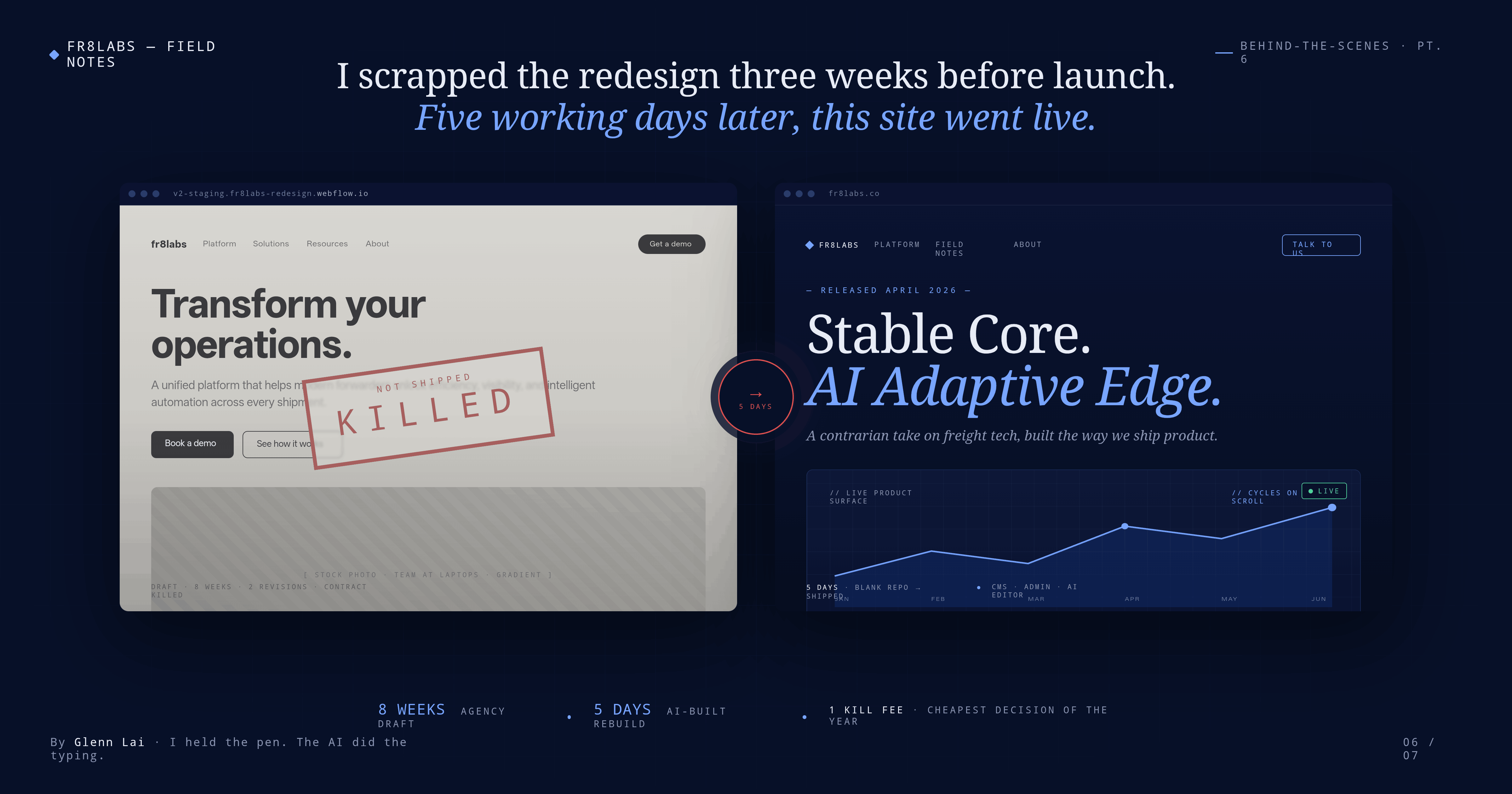
In late March I had an agency website that was almost done. Not great, not bad. Eight weeks of back-and-forth, two rounds of revisions, copy that read like the agency had read our pitch deck and given me back a slightly less interesting version of it. They were getting ready to hand over the Webflow source. We had a launch date.
I killed it. Five working days later, the site you're reading went live.
I'm writing this down because the why matters more than the how, and most "I built this with AI" posts skip the why.
The agency wasn't bad. They did exactly what we paid them for — read our material, interview a few stakeholders, produce a coherent marketing site in the standard SaaS template, push pixels around in Webflow until it looked clean. The result was fine. The problem was that fine isn't enough when your positioning is contrarian.
Fr8Labs tells the freight tech market a hard story: every other vendor says they're AI-native, we say we have a deterministic core and AI at the edge. That's a story you can't tell in stock-photo language. The agency softened it because softening was their default. By the time the third revision came back, the contrarian claim was a footnote and the homepage led with "transform your operations." I knew when I read it that I had two choices — ship something that didn't say what we actually believed, or scrap it and start over with someone who couldn't soften the message.
The someone, in this case, was me, and the tool was an AI coding agent.
I'm not a frontend designer. Eight years ago I was a non-technical co-founder who copy-pasted from Stack Overflow. I still couldn't tell you why one CSS framework wins out over another. But I can describe what I want. "The first section is dark. It says 'Stable Core. AI Adaptive Edge.' under the headline. It needs a sticky monitor on the right that cycles through three real product surfaces as you scroll." That's enough now.
The AI wrote the components. I reviewed them, asked for tweaks, sent screenshots back when something looked wrong, asked for a different visual when the first try missed the mark. Five days from a blank repository to the site you're on now, including a custom CMS layer for this blog, an admin UI to publish from, and an AI editor that reads our brand guide and rewrites posts in our voice.
I want to be careful not to oversell this. AI-built does not mean autonomous. It means I held a pen, the AI wrote, and I edited. The judgment was mine — what to say, what to cut, when to push back, when "good enough" was actually good enough. That's the part that doesn't outsource. The part that did outsource was the typing.
There's a question I'm now asking every vendor my team evaluates, and I think every freight tech buyer should ask it too. If you had to rebuild your product today, with the tooling that exists in 2026, would you build it the same way you originally did? If they say yes — either they're being polite, or they haven't really been paying attention. If they say no, ask the harder question: so why are you still selling the old version?
For us, the answer was: we're not. The website you're on isn't the product, but it is a sample of what the team can ship at speed when AI is in the workflow. The product itself runs on the same principle — deterministic where it has to be, AI-multiplied where it doesn't.
The agency was kind about it. The contract had a kill fee. We paid it. Cheapest decision I've made in a year.
Next in series: Why we stopped building new modules in full UX →