Phase 2, Part 1. The launch series (Parts 1-4) explained why we rebuilt around AI and where we drew the line. This series is the proof — three concrete things that happened on the inside as a result.
For most of last year, one of our PMs ran a queue I couldn't get below three weeks. Customers wanted document layout changes — a column added to a manifest, a logo rotated, a date format flipped from DD/MM to MM/DD because their agent in another country couldn't read it. None of it was hard. All of it was billable. And every request still went through the same loop: PM gathers requirements, designer mocks it, engineer implements it, PM tests it, customer signs off. Three weeks, sometimes four.
The work wasn't the problem. The handoffs were. Each step had a queue, and the queues compounded.
I've written before about where we let AI in and where we don't. The accounting layer stays deterministic. The customer-facing automation layer is where AI earns its keep. Document templates sit firmly on the AI side — high volume, low individual risk, fully reviewable before anything reaches a customer.
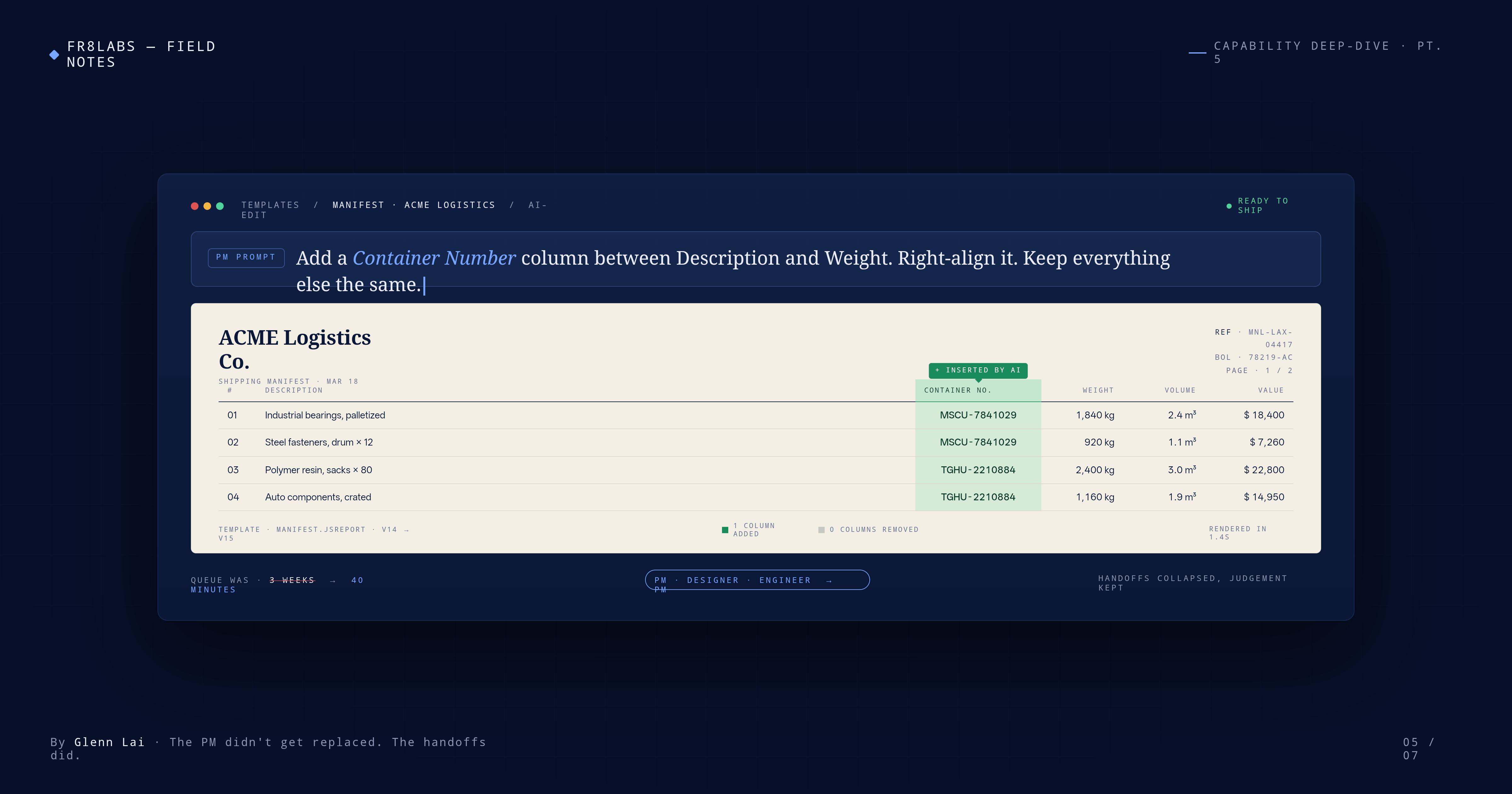
So we built a template editor that lets the PM describe the change in plain English. "Add a Container Number column between the Description and the Weight columns. Right-align it." The editor reads the existing template, proposes a diff, renders the result, and the PM ships it.
The first week we turned this on, the queue went from three weeks to forty minutes. Not because we automated the PM's job — we didn't. The PM still validates every change, talks to the customer, signs off. We automated the handoffs. The designer step folded in. The engineer step folded in. The PM kept the parts of the role that required judgment — was this what the customer actually meant, does this work for their downstream consignee, does this comply with what their broker needs — and lost the parts that were just translation.
A few months in, I promoted them. Not because they were doing more work. Because they were doing better work — the kind that scales — and they had the bandwidth to do it.
This is the part of the AI conversation I wish more freight tech vendors would talk about honestly. The interesting question isn't will AI replace the people who do this work today. The interesting question is which parts of their job are translation, and which parts are judgment. Translation collapses fast. Judgment is what's left, and judgment is what we hire for.
The operations roles with the most leverage now, on our team and from what I've seen on our customers' teams, tend to be the ones who learned to direct AI tooling rather than execute the rote tasks themselves. They aren't doing less. They're doing more, on harder problems.
If you're a forwarder running an ops team and your team is buried in document edits, layout fixes, manifest tweaks — that work is going to compress this year whether you choose it or not. The choice is whether the compression happens to your team, or with them.
We're betting on with.
Next in series: I killed a nearly-finished agency website and AI-built this one in five working days →