Before Fr8Labs, in a previous life in FMCG distribution, I ran a war room. Twenty-odd people. Six operators watching orders and stock move in real time, and behind them a full data-engineering team with a proper warehouse. By the standards of the day it was good infrastructure. We could answer almost any question about the business — eventually.
That last word was the problem. A new angle on the data, or a dashboard nobody had built yet, took one to two weeks. Not because anyone was slow. Because the work moved through a chain: someone scopes the question, someone models the data, someone builds the view, someone checks it. Each link had a queue, and the queues stacked.
Two weeks doesn't sound bad until you set it next to a board meeting. The number that would have changed how a decision went — the one that reframes a negotiation, or makes the right first impression with a partner — needed to be on the table that week. By the time it arrived, the room had moved on. Two weeks was impressive to the people who knew how the sausage was made. It was useless to the people in the meeting.
And the bill for it. A war room plus a data team is real operating expense monthly, and a lot of what it produced were answers that landed a fortnight after the moment that needed them.
I sat with that for years. When I started Fr8Labs, it went on the short list of problems I took personally — the kind of itch you build a company partly to scratch. Every business I've ever worked in wants the same thing: to ask a question of its own data and get the answer while the question still matters.
Here's where we've landed.
You don't ask someone to build the report. You ask the data.
- "Who are my top 10 consignees this quarter?"
- "What's my gross margin by trade lane this year?"
- "Show me overdue AR by customer."
- "How many shipments did we handle this year, by month?"
The answer comes back as a chart or a table. If it's useful, you turn it into a dashboard or schedule it to your inbox. If it's not quite the cut you wanted, you ask again — a different breakdown, a tighter date range — and the loop is seconds, not a sprint.
The part I find genuinely exciting isn't that this works inside one product. It's that your freight data is now reachable through a secure connector layer — so you can ask these questions from the assistant your team already uses. We've published an official Fr8Labs Analytics app for ChatGPT, and because it runs on an open connector standard (MCP), the same door opens to the other assistants your people already live in.
For a forwarder, this lands exactly where the friction hides. Reporting is one of those quiet loops that eats more time than anyone budgets for. Someone needs a number. Someone exports a spreadsheet. Someone edits it. Someone asks for a slightly different breakdown. Then it goes round again. The work isn't hard; the handoffs are. We're trying to make that loop much shorter.
A word on the guardrails, because "let an AI assistant near your freight data" should make a careful operator pause. It's read-only. It's scoped to your company, enforced at the database level, not just in the interface. You connect through your own Fr8Labs login, and access can be revoked at any time. Reports can only be emailed within your own company domain. The principle is the one we apply everywhere: the core stays deterministic and locked down; AI sits at the edge, where it reads and drafts but never quietly changes the record. I've written before about where we let AI in and where we don't — this is that line, applied to your data.
A few weeks after we opened that connector, I got a message from Paul, who runs Good Logistics Terminal Group in Indonesia. Nobody walked him through it. He'd pulled his group's gross profit — broken down by month and by customer — and then kept going on his own: AR, AP, a pass over SG&A, where he found discrepancies worth chasing. All of it self-serve, in the assistant he already had open.
"I built this [this monthly gross-profit breakdown per customer] in a few minutes. Then I pulled AR and AP, reviewed the SG&A — and found discrepancies. It's incredible."
— Paul Good,Chairman, GL Terminal Indonesia, Over 40 years industry experience across Agility, Kuehne + Nagel, BSA and Seko
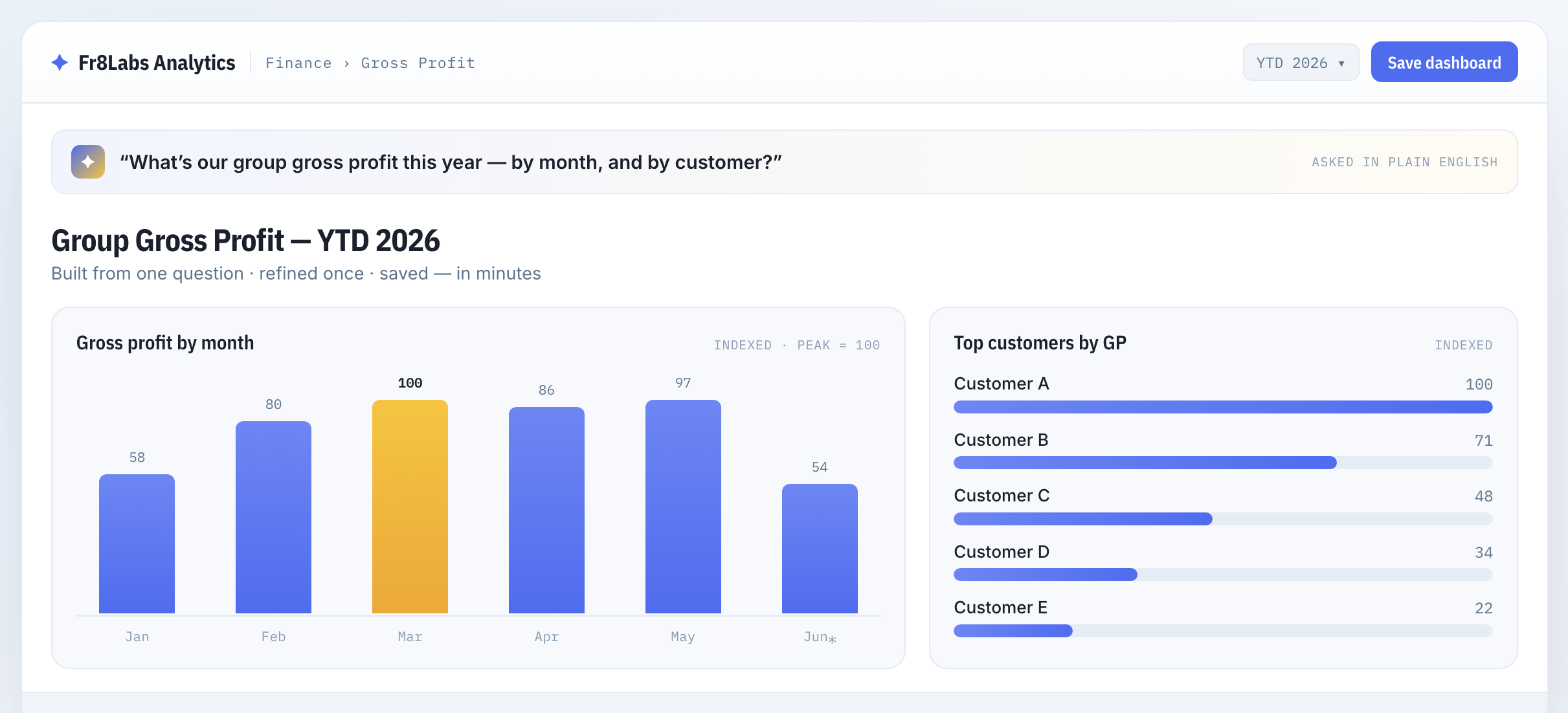 The kind of view Paul built — gross profit by month and by customer. Customer names removed and figures indexed; the point is the timeline, minutes not weeks.
That's the whole thesis, handed back to me by a customer in his own words — and he reached for it without anyone asking him to. Note what he actually did with it: he didn't just read a chart, he went hunting, and the read-only connector was exactly enough to let him find real discrepancies without ever putting the underlying records at risk. The version of me running that war room would not have believed the timeline.
This is still early, and super users will find the rough edges before we do. But the direction is clear, and I think it's where freight software is heading. Less "please build me a report." More "ask the system, verify the answer, save what's useful." The judgment — is this the right question, does this number mean what I think it means — stays with the person. The fetching and the formatting stop being a two-week tax.
If you run a forwarding operation and your team is stuck in the export-edit-repeat loop, it's worth a look. I'm especially curious how the operators push it — the people who, like my war room six, live closest to the data and have wanted to ask it questions directly for years.