Every product has a few users who use it harder than you built it for. Ours showed up about a month after we let forwarders connect their own freight data to the AI assistant they already use, and started asking it questions in plain English.
A dozen or so of them. My super users. And they didn't ask the questions I expected.
I thought they'd ask about shipments. Where's my container, how many jobs this week. Some did. But most of what they asked was money.
- Full profit and loss for the month, by account category.
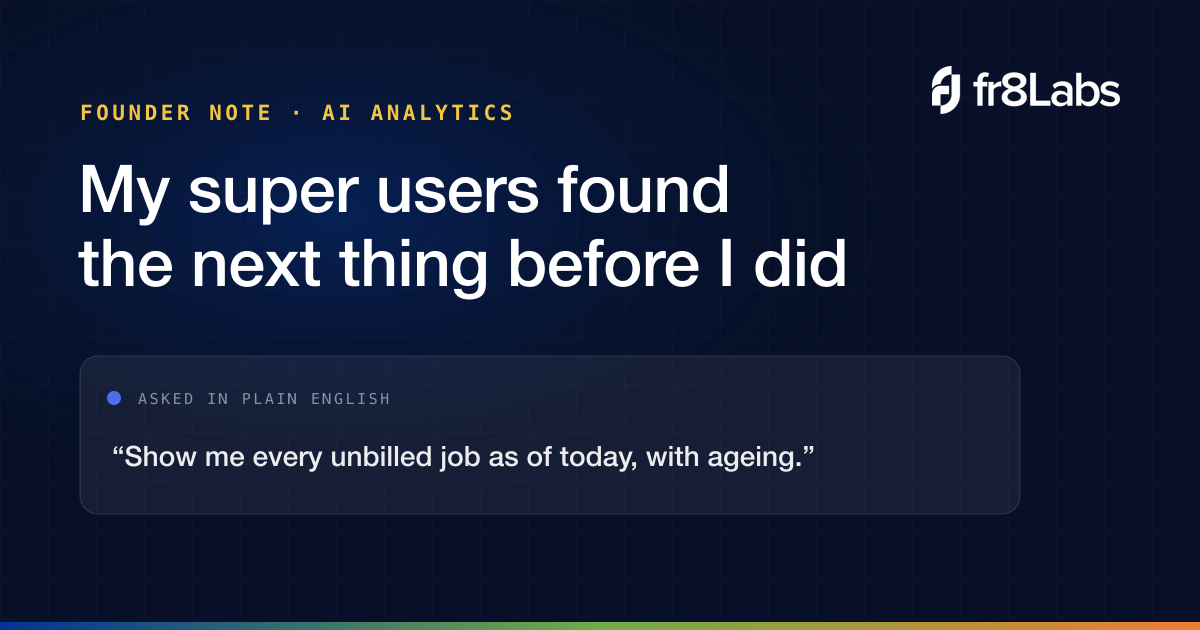
- Every unbilled job as of today, with ageing.
- Cash position, and receivables due in the next seven days.
- Margin per shipment, flagged where revenue is positive but profit is negative.
- Which accounts are holding unusual, one-off entries.
These are the questions a CFO asks a finance team on a Monday. Except there's no finance team in the loop, and no Monday wait.
One of them is Paul, who runs a forwarder in Indonesia. On his way to dinner one evening he asked his data about a single invoice, one worth the better part of a billion rupiah. It had slipped. Left alone it would have sat unbilled for another three or four weeks, and for a forwarder that is not a filing delay. That is working capital parked in someone else's account while you fund the next shipments yourself. He caught it before the main course, and billed it the next morning instead of the next month. He had been chasing that kind of invoice for years. This time he just asked.
And it isn't one power user per company. A director at a global forwarder built his sales team's conversion report himself, in a chat, and his whole office started doing the same. Four people from one branch, in there every week, each asking their own slice.
I'm wary of quoting people, so here are two messages, word for word, from forwarders who haven't asked to be named:
"I'm absolutely loving the integration. It's fantastic."
"I tried this yesterday and today, it's pretty amazing. Thanks for building it."
I didn't write those. I just kept them.
The wall they all hit
Here's the thing my super users showed me, without meaning to.
The assistant tells them what's wrong. It doesn't fix it. It finds the unbilled invoice, and then someone still has to go and raise it. It spots the overcharge on a vendor bill, and someone still has to go and query it. Paul still had to bill that invoice himself the next morning.
Every one of them, sooner or later, asks a question that's really a request. Can you raise this. Draft that quote. Create the job. And today the answer is: not yet, go do it in the system.
That gap — between seeing and doing — is the next thing we're shipping. We call it Fr8Labs Actions.
Same assistant, same chat. But now, when it finds the invoice, it can draft the invoice. When an inquiry comes in, it can build the quote off your live rates. When a booking confirms, it can create the job from the bill of lading. Then it hands the whole thing to you, and waits.
Because the one rule underneath all of it is that the assistant never files anything on its own. It proposes; you approve. It's locked to your own company's data and cannot touch anyone else's, or post a single thing, without your explicit yes. That's not a limitation I'm apologising for. On money, cargo and compliance, the human "yes" is the feature. Ask your data anything. Then ask it to do something about it, and check its work.
It's close. My super users will get it first.
Why this is even possible
None of this works if your data is scattered across spreadsheets, inboxes and a legacy system that can't answer back. It works because it's sitting on one clean, governed core. That's the unglamorous part nobody blogs about, and it's the whole foundation. Asking is just the first thing a good core unlocks. Doing is next.
And we're quietly brewing something deeper after that. But that's a story for another day.
Curious what it looks like against your own numbers? Here's how the connector works.