Launch series: ← Part 1: the WiseTech turn · ← Part 2: the optimist turn · Part 3 (you're here) · Part 4: where we drew the line →
Parts 1 and 2 of this series laid out the shift happening in freight software: the old shape of software is commoditizing, and the opportunity is actually bigger because AI makes services-as-software a real business model. The piece that makes me confident in any of it is the customers we talk to.
This post is about one conversation.
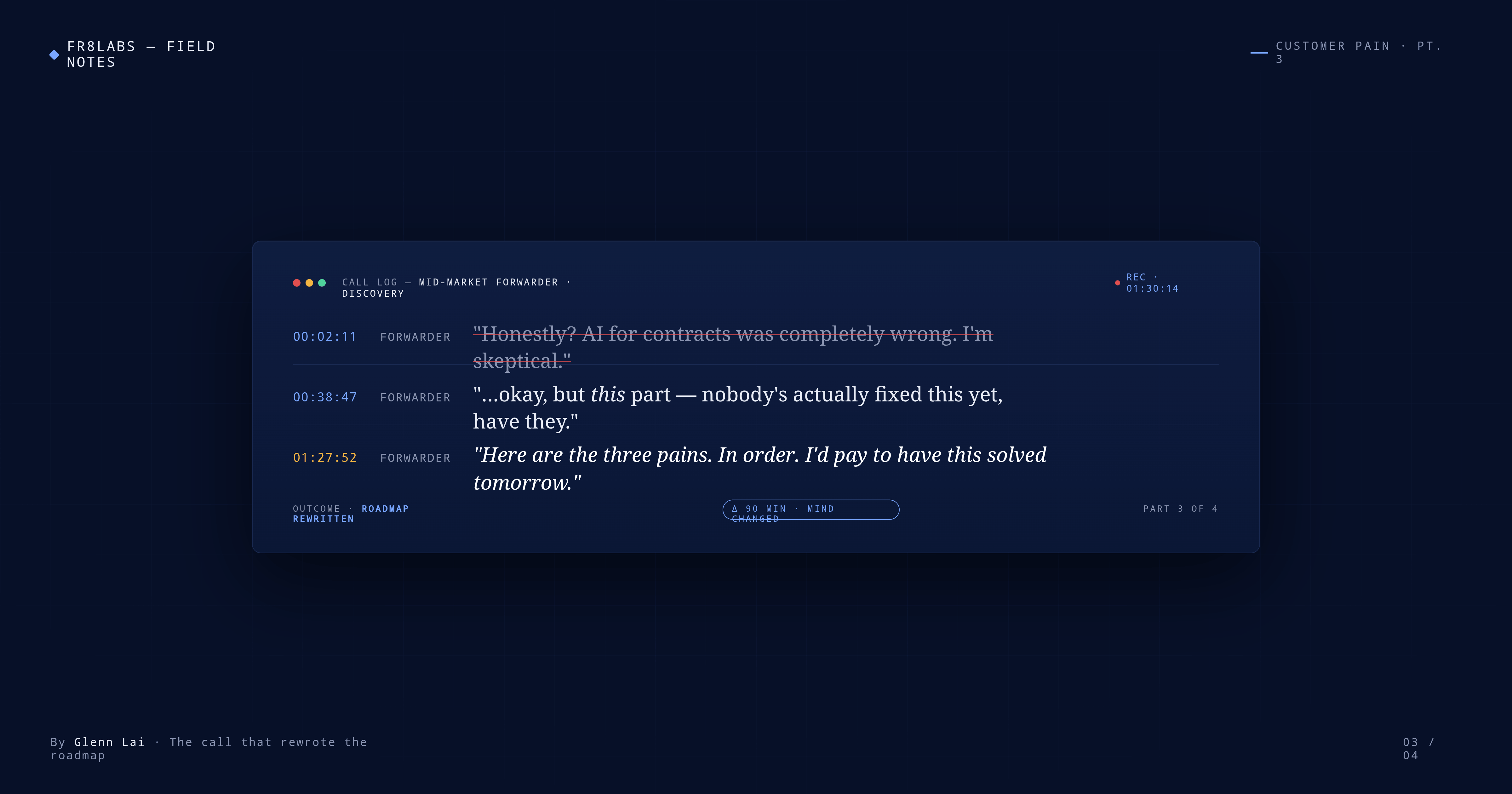
Last month I pitched a mid-market forwarder. Good operator, a few hundred shipments a day, multi-country, the kind of customer we build for. The call opened the way a lot of these calls open in 2026 — with a sentence I was not expecting:
"Honestly, Glenn, we hear a lot about AI, but we're skeptical. We saw forwarders working with us use it for contracts, and it was completely wrong. We can't see how this can work for us yet."
This is a good forwarder saying an honest thing. He'd watched a peer ship AI on something important. It had failed badly enough to leave an impression. His read — entirely reasonable — was: "I don't understand where the line is between AI that works and AI that doesn't. Until I do, I'd rather not be the next cautionary tale."
That's a rational position. It's also the position the market leader's sales motion has been counting on for years — stay with the safe thing; let someone else be the experiment.
I didn't argue. We just did the demo.
Ninety minutes later, the same forwarder said something almost the opposite:
"Actually, it seems there's a big opportunity. And it's not just AI — it's your automation approach. We face manpower issues; the capacity fix is always 'hire more,' and that's a pain. Also, we don't think data entry is very empowering. And we often feel a lack of insight — asking my team to manually compile an agent report before a conference is a dilemma, because they're already packed, and it's extremely manual for them to do."
He named three pains in one breath. Each is a separate problem. Each is the same shape of problem.
What he actually said — underneath the words
1. Manpower: "the capacity fix is always 'hire more'"
This is the 80/20 scaling tax every professional-services-shaped business pays. You can't scale on software alone, because 20% of every customer's workflow is custom to that customer. So you hire. You hire until margins flatten, then you either raise prices (customers leave), cut customization (customers leave), or keep hiring (margins collapse). It's the same shape of trap every mid-market freight forwarder I've spoken to over the past eighteen months has been sitting in.
What he's really asking for, underneath: a way to capture more volume without a linear increase in headcount. Not a better CRM. Not a better dashboard. A different function for what software is for.
2. Dignity: "we don't think data entry is very empowering"
This is the most overlooked pain in freight software. A forwarder's ops team is not doing dumb work; these are highly-trained professionals whose daily output includes a meaningful amount of manual re-keying — take a value from one document, type it into another; pull data from one portal, paste it into another; convert formats that shouldn't need converting.
"Not empowering" is the understated version of what he really means, which is: my best people do not stay in jobs where the most visible 60% of their day is transcription. Data entry is a retention problem. It's also a recruiting problem. Forwarders in 2026 aren't losing out to AI-native competitors because their tools are worse. They're losing out because their entry-level roles are less compelling than the entry-level roles at a modern software company, and the career ladder starts lower.
What he's asking for, underneath: software that makes the human part of the job matter more, not less.
3. Insight: "manually compile an agent report before a conference"
The specific example here is killing. Once a quarter, this forwarder's commercial team has to put together a report on the accounts they serve — volume, margin, issue trends, agent performance — for an industry event. The data exists; it's in the platform. Extracting it, shaping it, writing it up, getting it into a form a human can present with: all of that is manual work, and the people best-equipped to do it are the people most booked during the run-up to any event.
This is the classic shape of an AI Analytics problem. The forwarder isn't short of data. He's short of the bandwidth to turn data into a narrative. That's not a reporting-module problem (we already have those). It's a "I need a colleague who can write up the story my data is telling, before 6pm on Friday" problem.
What he's asking for, underneath: an analyst that doesn't sleep and bills by output, not by hour.
What changed his mind in the demo
The thing worth noticing about the two quotes is how specific the opportunity framing is compared to the skepticism framing. The skepticism was generic — AI-had-a-bad-run. The opportunity is three specific pains, each named in the forwarder's own words, after he'd watched software demonstrably do the intelligence work he'd assumed software couldn't do.
The sentence I keep coming back to is this one: "it's not just AI — it's your automation approach."
That's the right articulation of what a customer actually wants in 2026. Not "AI" as an abstract capability. An approach — an opinionated, well-engineered way of using AI that respects the line between what it should and shouldn't do. The peer's contract AI that failed him was AI without discipline. Our demo showed AI with discipline — specific things it's allowed to do, specific things a human still approves, specific outcomes it delivers on a timeline no team of humans can.
This is, almost word for word, what Part 2 of this series was trying to articulate. Services-as-software is not "let AI do the work"; it is "let AI do the intelligence work, let humans keep the judgment work, build the platform that draws the line cleanly enough that customers trust it." This forwarder walked into the call already sensing that's the right shape. He just needed to see it done without the rough edges he'd seen elsewhere.
What it's doing to our roadmap right now
The three pains this forwarder named aren't unique to him. They're the modal mid-market forwarder's pain, stated more precisely than most forwarders state them. Our roadmap for the next two quarters is basically organized around these three:
- Manpower pain → the translator layer. AI colleagues that handle the intelligence-work slices (document reading, rate drafting, status compilation, customs declaration drafting) inside the forwarder's existing platform, without a new app to adopt.
- Dignity pain → every new feature we ship now is evaluated on "does this move a human from re-keying to judgment?" If it doesn't, it gets deprioritized. This has cost us a few features that were in the old roadmap. They shouldn't have been there.
- Insight pain → the AI Analytics surface, pushed harder than any other part of the platform through the rest of 2026. Natural-language questions against the forwarder's own data, report generation, agent / account narratives. Not a dashboard upgrade; a writing-partner for the commercial team.
None of those are finished. The platform has pieces of each. What changed after this conversation is the ordering and the confidence level. This forwarder articulated in ninety minutes what I'd been trying to articulate in three pages of a strategy doc. He did a better job of it.
What I'd ask you to take away, if you're a forwarder
Two things.
One: the vendor conversation you're about to have over the next twelve months will sort itself into two piles. Some vendors will keep pitching you modules. Some will pitch you outcomes — specifically, outcomes that take the three pains above seriously. The difference is worth listening for.
Two: the right question isn't "does your AI work?" It's "where do you let AI work, and where don't you?" A vendor who can answer that cleanly has already done the hard thinking. A vendor who's enthusiastic about AI everywhere has not. Part 4 of this series, which is the last one, goes into the line we drew at Fr8Labs.
Next → Part 4: We wanted AI everywhere. Here's where we drew the line.
— Glenn